Antigravity vs. Kiro — A Practical, Comparison for Today’s Engineering Teams

Agent-first IDEs are quickly becoming the next major shift in software development. Among the new entrants, two tools dominate the conversation: Google’s Antigravity and Amazon’s Kiro. Both promise to elevate developers from code writers to orchestrators, but they take distinctly different approaches regarding speed, safety, reliability, and autonomy.
This post breaks down their strengths and weaknesses based on real developer experiences and early community feedback, giving you a clear, honest comparison to help your team choose the right tool.
Overview
Google Antigravity
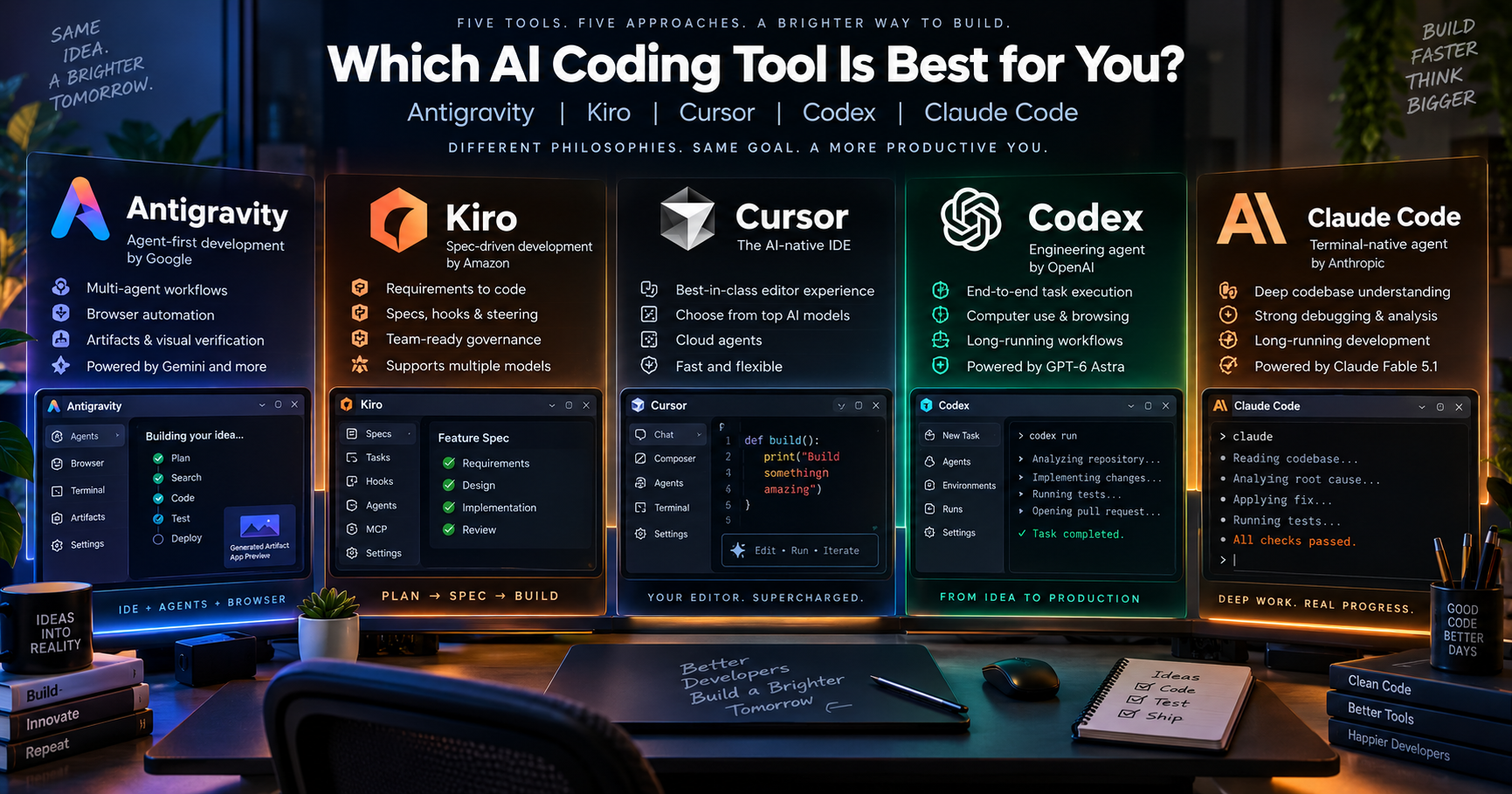
Antigravity is Google’s bold entry into agentic development. It aims to be fast, fluid, and deeply capable—powered by the Gemini 3 model and built around a dedicated Agent Manager surface. Antigravity feels modern and ambitious, with agents capable of planning, executing, and validating multi-step tasks that span the editor, terminal, and browser.
Amazon Kiro
Kiro, on the other hand, is designed with a stability-first mindset. It’s built on Code OSS and takes a spec-driven approach where developers define intent through specs, hooks, and steering files. Instead of chasing maximal autonomy, Kiro focuses on predictability, safety, and giving developers full control—even if that means being slower or less “magical.”
Feature Comparison Table
| Category | Antigravity | Kiro |
| Philosophy | Fast, autonomous, agent-driven execution | Predictable, stable, spec-driven workflows |
| Developer Experience | Modern UI, fluid interactions, artifact-based verification | Familiar VS Code-like experience, governance-first |
| Agent Behavior | Highly autonomous; sometimes unpredictable | Controlled, predictable, reproducible |
| Performance | Very fast, handles complex tasks | Slower but safer; fewer surprises |
| Best For | Rapid prototyping, fast iteration, parallel tasks | Infrastructure as Code, long-term reliability, cautious environments |
| Risk Level | Higher—due to agent unpredictability | Lower—due to strict constraints and steering |
| Model Strength | Powered by Gemini 3 Pro | Safe-by-default approach with predictable execution |
| Weaknesses | Reliability concerns, occasional context misses, trust issues | Less advanced AI capabilities, slower pace, less autonomy |
Strengths and Weaknesses
Antigravity Strengths
Fast and fluid experience — its speed is consistently praised.
Advanced agent autonomy — agents can plan multi-step tasks across tools.
Powerful for prototyping — quick to experiment and build features end-to-end.
Impressive newness — despite being early, the capability is already strong.
Artifacts — screenshots, recordings, and task plans help with verification.
Antigravity Weaknesses
Trust issues — developers report agents taking unexpected actions.
Unpredictability — sometimes fails to respect project structure or context.
Security concerns — autonomy may feel risky for critical environments.
Early-stage roughness — bugs, instability, and inconsistent behavior.
Not ideal for IaC or production-sensitive tasks — too much autonomy.
Kiro Strengths
Highly reliable and predictable — developers highlight its consistency.
Feels safe — less autonomy means fewer surprises during execution.
Great for critical workflows — especially infrastructure and backend work.
Spec-driven governance — specs, hooks, and steering ensure intent is clear.
Team-friendly — reproducible output reduces ambiguity and mistakes.
Kiro Weaknesses
Slower compared to Antigravity — feels more bureaucratic.
Less “magical” — fewer surprising leaps or big wins.
Not as fluid or futuristic — prioritizes control over creativity.
AI is less advanced — capabilities feel more limited compared to Gemini.
Decision Guide
Choose Antigravity if you:
Want high-speed development
Need advanced AI capabilities
Work in early-stage product development
Value autonomous agents handling multi-step tasks
Don’t mind occasional unpredictability for the sake of velocity
Choose Kiro if you:
Prioritize stability and safety
Build infrastructure or mission-critical systems
Need predictable, reproducible agent behavior
Want stricter control over AI interactions
Prefer tools that behave consistently across team environments
Realistic Conclusion (Not Hype, Just Truth)
The truth is simple: neither Antigravity nor Kiro is objectively “better.”
They are built for different priorities and different types of engineering teams.
Antigravity is the future-facing option—fast, ambitious, and incredibly capable, but with early-stage unpredictability that makes it better suited for experimentation and rapid development than safety-critical work.
Kiro is the stability-first option—consistent, controlled, and predictable, ideal for teams who need reliability above all else, even if that means sacrificing speed and autonomy.
For most startups and product-focused teams, Antigravity feels exciting and can dramatically accelerate iteration.
For teams building infrastructure, large distributed systems, or environments with strict operational requirements, Kiro is still the safer, more responsible choice.
Both tools are pushing the industry forward, but for now, each one serves a different reality.
Disclaimer: Portions of the image were generated using AI. Google Antigravity and Kiro logos are used for informational comparison only and may not depict their exact official designs. No affiliation or endorsement is implied.
Comments
Join the discussionNo comments yet. Be the first to comment.