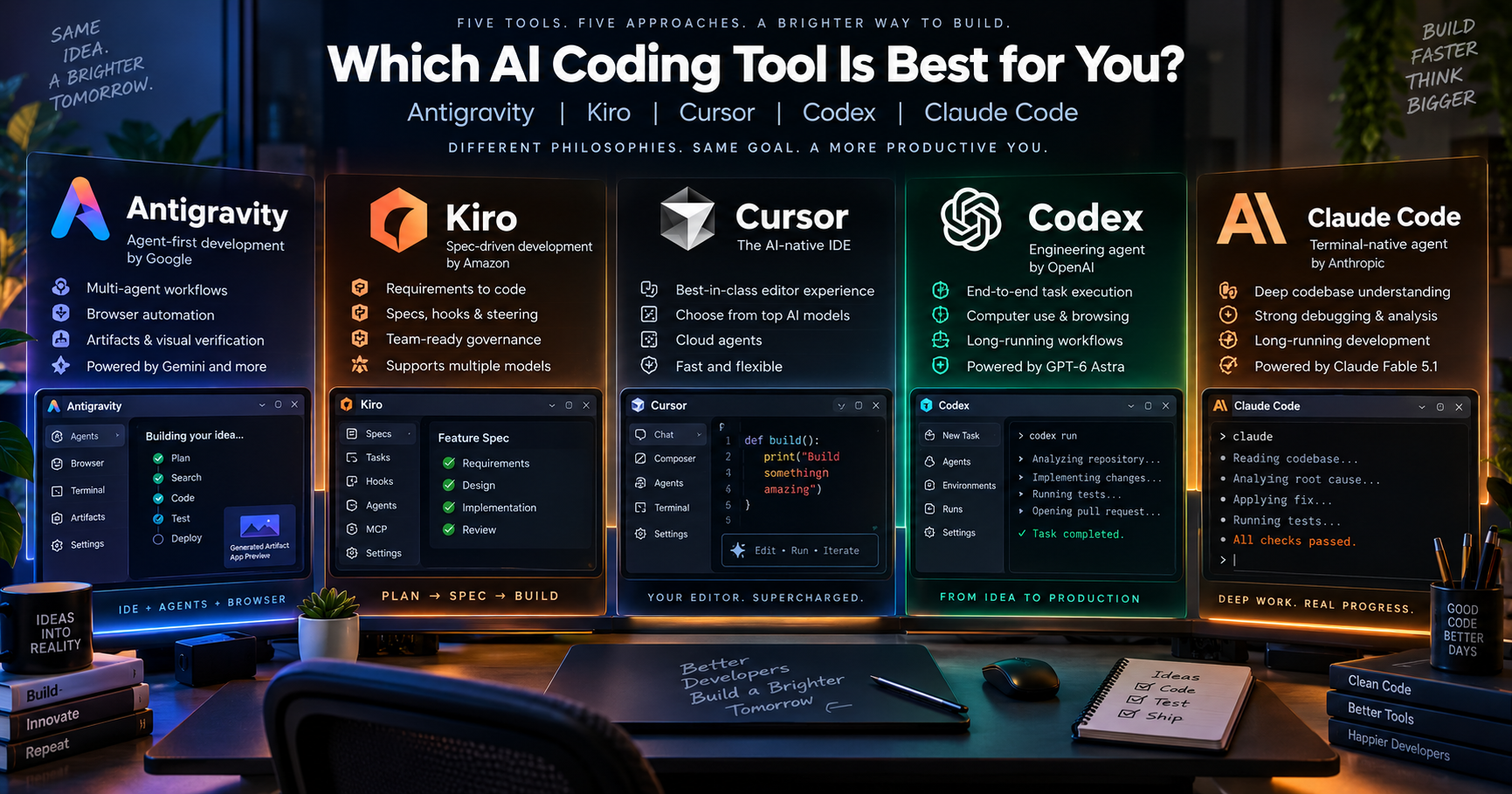
OpenAI Codex vs Claude Code — GPT-6 Astra vs Claude Fable 5.1
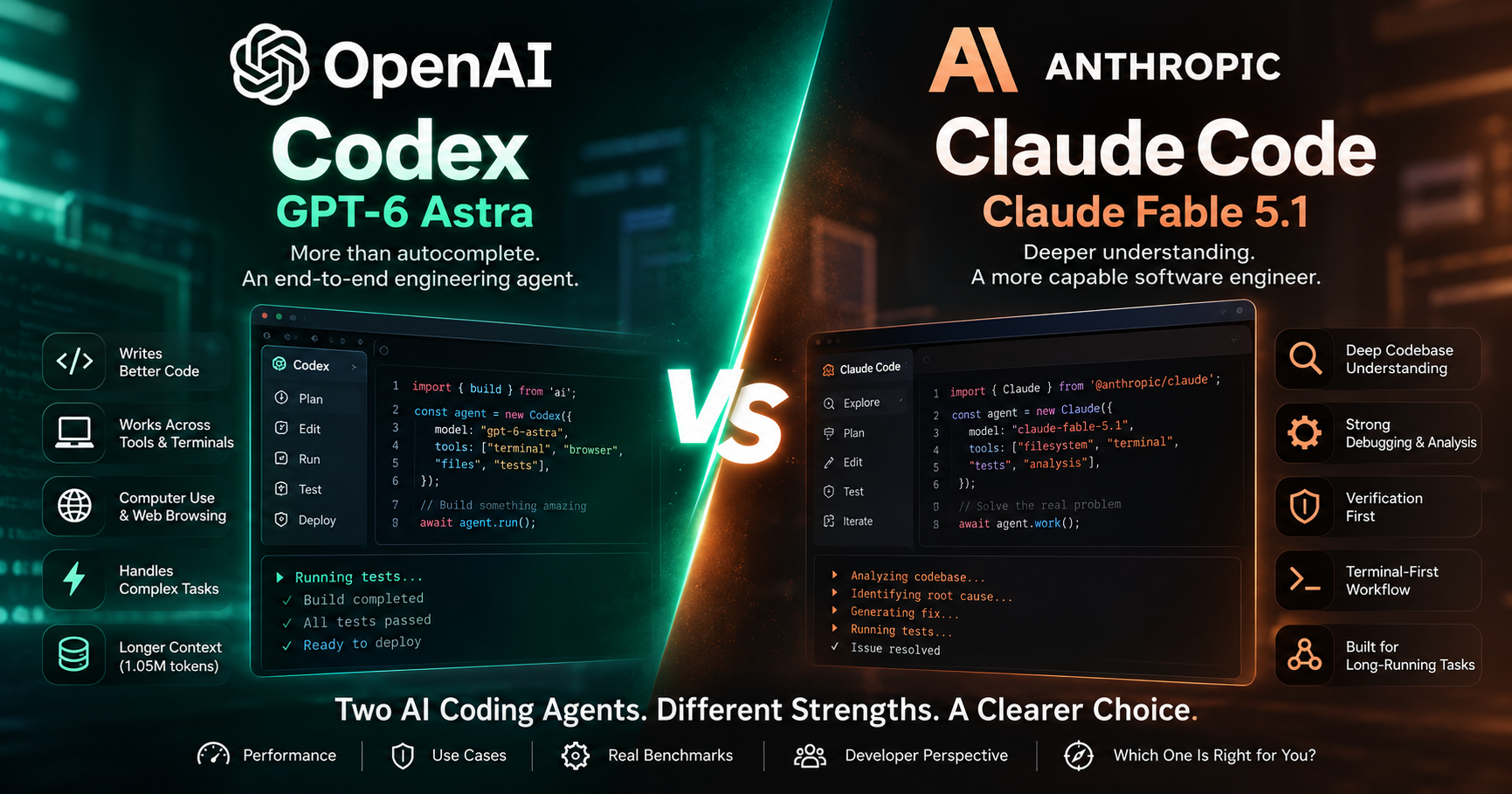
AI coding agents are quickly becoming a core part of modern software development. They can inspect repositories, modify multiple files, run commands, debug failures, browse the web, and handle long-running engineering tasks instead of simply suggesting code.
Two of the strongest options today are OpenAI Codex powered by GPT-6 Astra and Anthropic Claude Code powered by Claude Fable 5.1.
Both target serious software engineering, but they take different approaches. Codex focuses on broad, end-to-end execution across code, terminals and computers, while Claude Code is built around deep repository reasoning, debugging, verification and long-running development.
This comparison breaks down where each is stronger, where they fall short, and which one makes more sense for different developers.
Overview
OpenAI Codex + GPT-6 Astra
Codex is designed as an engineering agent, not simply an AI assistant inside an editor. It can inspect repositories, make changes, run tests, use terminals and browsers, and continue working through multi-step tasks.
GPT-6 Astra is OpenAI's flagship model for complex reasoning, coding, computer use and broader end-to-end workflows. Codex also supports long-running work through context preservation, helping earlier task information remain available during extended sessions.
Claude Code + Claude Fable 5.1
Claude Code takes a more repository- and terminal-centric approach.
It gives Claude direct access to the project, tools and shell, making it particularly suited to difficult debugging, large refactors and long-running engineering work.
Anthropic positions Fable 5.1 around complex coding, root-cause analysis, verification and autonomous development.
In simple terms:
Codex is the broader engineering operator.
Claude Code is the deeper software-engineering specialist.
Feature Comparison Table
| Category | OpenAI Codex + GPT-6 Astra | Claude Code + Claude Fable 5.1 |
|---|---|---|
| Philosophy | End-to-end agentic engineering | Deep autonomous software engineering |
| Developer Experience | App, IDE, CLI and cloud workflows | Terminal-first workflow |
| Coding | Excellent | Excellent |
| Terminal Work | Excellent | Excellent |
| Computer Use | Major strength | Strong |
| Long-Running Tasks | Strong context preservation | Strong autonomous execution |
| Context Window | 1.05M tokens | Large-context frontier model |
| API Pricing | \(10 input / \)50 output per 1M tokens | \(10 input / \)50 output per 1M tokens |
| Best For | Broad engineering and computer-use workflows | Debugging, repositories and long-running coding |
| Main Advantage | Breadth and task execution | Engineering depth and verification |
| Main Weakness | Less model freedom | More terminal-centric |
| Overall Character | Engineering operator | Software-engineering specialist |
Performance: What Do the Benchmarks Say?
There is no single benchmark that measures “real software engineering.”
Different evaluations test different things, so a leaderboard should be treated as evidence—not as an absolute ranking.
OpenAI's published Astra comparison reports:
| Evaluation | GPT-6 Astra | Claude Fable 5.1 |
|---|---|---|
| Terminal-Bench 4.0 | 57.9% | 55.8% |
| DeepSWE v1.1 | 74.1% | 67.4% |
| FrontierCode 1.1 Extended | 64.5% | 63.6% |
| FrontierCode 1.1 Main | 53.3% | 50.9% |
Astra therefore has the stronger published result across several of these major coding evaluations, but the gap is not large enough to call it a universal winner.
Fable 5.1 remains highly competitive and also reports strong results on evaluations including CursorBench, OSWorld and AutomationBench.
The practical conclusion is simple:
Astra leads several important coding benchmarks. Fable 5.1 remains firmly in the frontier tier.
Codex Strengths
End-to-end execution — handles larger tasks instead of only generating code.
Computer use — particularly strong when coding must interact with browsers or software.
Strong terminal performance — competitive on complex tool-based workflows.
Long-running context — Codex can preserve useful information across extended tasks.
Broad workflow — works across IDE, CLI, cloud and other environments.
Codex Weaknesses
Less model freedom than platforms built around multiple providers.
Higher governance requirements as autonomy and computer access increase.
Frontier-level capability is unnecessary for many small coding tasks.
Codex makes the most sense when the task is bigger than simply editing a source file.
Claude Code Strengths
Deep repository reasoning — particularly strong for complex codebases.
Debugging — heavily optimized around finding underlying problems rather than superficial fixes.
Verification — strong emphasis on testing and iterative validation.
Long-running development — designed for sustained autonomous engineering.
Terminal-native workflow — natural for developers who already live in the shell.
Claude Code Weaknesses
Terminal-first experience can be less approachable for GUI-first developers.
Less model diversity than multi-model environments such as Cursor or Kiro.
Heavy autonomous workloads can still become expensive.
Claude Code makes the most sense when the core problem is fundamentally software engineering rather than broad computer operation.
What Developers Actually Notice
Benchmarks matter, but developers do not ship benchmarks.
They ship software.
The most noticeable difference is therefore workflow.
Codex is increasingly designed to take responsibility for a broad chain of actions: understand the task, inspect the repository, modify code, execute commands, use a browser, test the result and continue working.
Claude Code is more concentrated on the engineering loop: understand the codebase, reason about the change, edit files, run tests, investigate failures and keep iterating.
That leads to a useful distinction:
Codex is broader.
Claude Code is more engineering-focused.
Neither description means the other cannot perform those tasks. It describes where each product is strongest.
Which One Is Better for Different Developers?
Choose Codex if you:
Want an end-to-end coding agent
Work across code, terminals, browsers and applications
Need computer-use capabilities
Handle complex multi-step engineering tasks
Want broader autonomous workflows
Choose Claude Code if you:
Spend most of your time in the terminal
Work with large or unfamiliar repositories
Do difficult debugging
Perform large refactors
Care about root-cause analysis and verification
Codex vs Claude Code for Specific Tasks
| Task | Better Pick | Why |
|---|---|---|
| Large repository refactor | Claude Code | Strong repository-focused reasoning |
| Complex terminal tasks | Codex | Higher published Terminal-Bench result |
| Difficult debugging | Claude Code | Strong root-cause focus |
| Browser + code workflow | Codex | Strong computer-use capabilities |
| Code review | Both | Both are highly capable |
| Frontend development | Both | No universal winner |
| Long-running coding | Both | Both support extended agentic work |
| General computer automation | Codex | Broader computer-use workflow |
| Repository-centered development | Claude Code | More deeply centered on the codebase |
One Important Reality About AI Coding Benchmarks
Do not build your engineering strategy around a leaderboard screenshot.
Benchmark performance depends on the model, agent harness, tools, infrastructure, configuration and task set.
Anthropic has shown that infrastructure configuration alone can produce meaningful variation in Terminal-Bench results. That makes small differences between frontier models less decisive than they may appear.
So:
A model winning one benchmark does not make it universally better.
What matters is whether it performs better on your repository, your tools, your tests and your actual engineering workload.
Realistic Conclusion (Not Hype, Just Truth)
The answer is not:
“Codex destroys Claude.”
And it is not:
“Claude is still the king of coding.”
The evidence does not justify either claim.
OpenAI Codex + GPT-6 Astra is the stronger choice for developers who want a broader engineering agent capable of working across code, terminals, browsers and computers. Its biggest advantage is breadth and end-to-end execution.
Claude Code + Claude Fable 5.1 is the stronger choice for developers focused on deep repository work, debugging, verification and long-running software engineering. Its biggest advantage is engineering depth.
So the practical decision is simple:
Pick Codex when you want a broader engineering operator.
Pick Claude Code when you want a deep software-engineering specialist.
For serious developers, the best answer may be to use both.
The winning workflow is not necessarily the agent with the highest benchmark score.
It is the one that can take a real engineering task, produce a correct change, verify it, and leave you with less work than you started with.
Disclaimer: Benchmark figures and product capabilities are based on publicly available OpenAI and Anthropic material and can change with model versions, tools, infrastructure and evaluation methodology. This article is an independent comparison and is not affiliated with or endorsed by OpenAI or Anthropic.