OpenAI GPT vs Google Gemini: Which Is Better for Coding?
For developers, the real Google vs OpenAI battle is no longer about chat quality.
It is about coding, reasoning, agents, debugging, tool use, context, and how reliably a model can finish real engineering work.
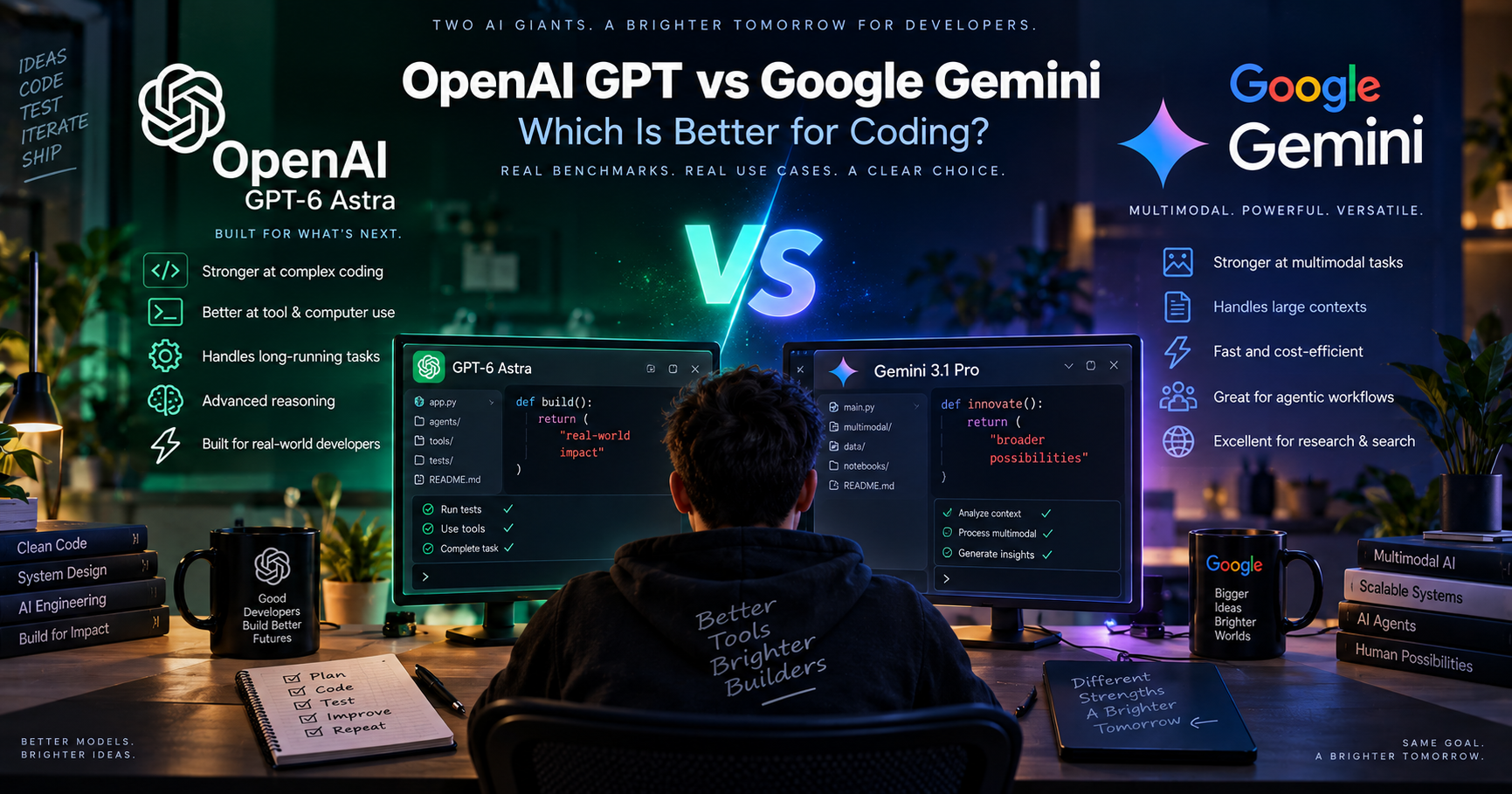
The current comparison is between OpenAI's GPT-6 Astra, GPT-5.6 Sol and GPT-5.6 Terra and Google's Gemini 3.1 Pro, Gemini 3.8 Flash and Gemini 3.7 Flash. OpenAI positions Astra for its hardest coding and reasoning workloads, while Google positions 3.1 Pro as its strongest general model and 3.8 Flash specifically for long-horizon software engineering and autonomous agents.
The important question is simple:
Which one should developers actually use?
Model Comparison
| Model | Best Position | Coding Strength | Main Advantage |
|---|---|---|---|
| GPT-6 Astra | OpenAI flagship | Excellent | End-to-end reasoning + coding + computer use |
| GPT-5.6 Sol | Professional workhorse | Excellent | Strong coding at lower cost |
| GPT-5.6 Terra | Cost-balanced | Very Strong | Performance/value |
| Gemini 3.1 Pro | Google flagship | Excellent | Multimodal + reasoning + huge context |
| Gemini 3.8 Flash | Fast coding workhorse | Very Strong | Speed + cost + long-horizon coding |
| Gemini 3.7 Flash | Previous Flash generation | Strong | Efficient agentic coding |
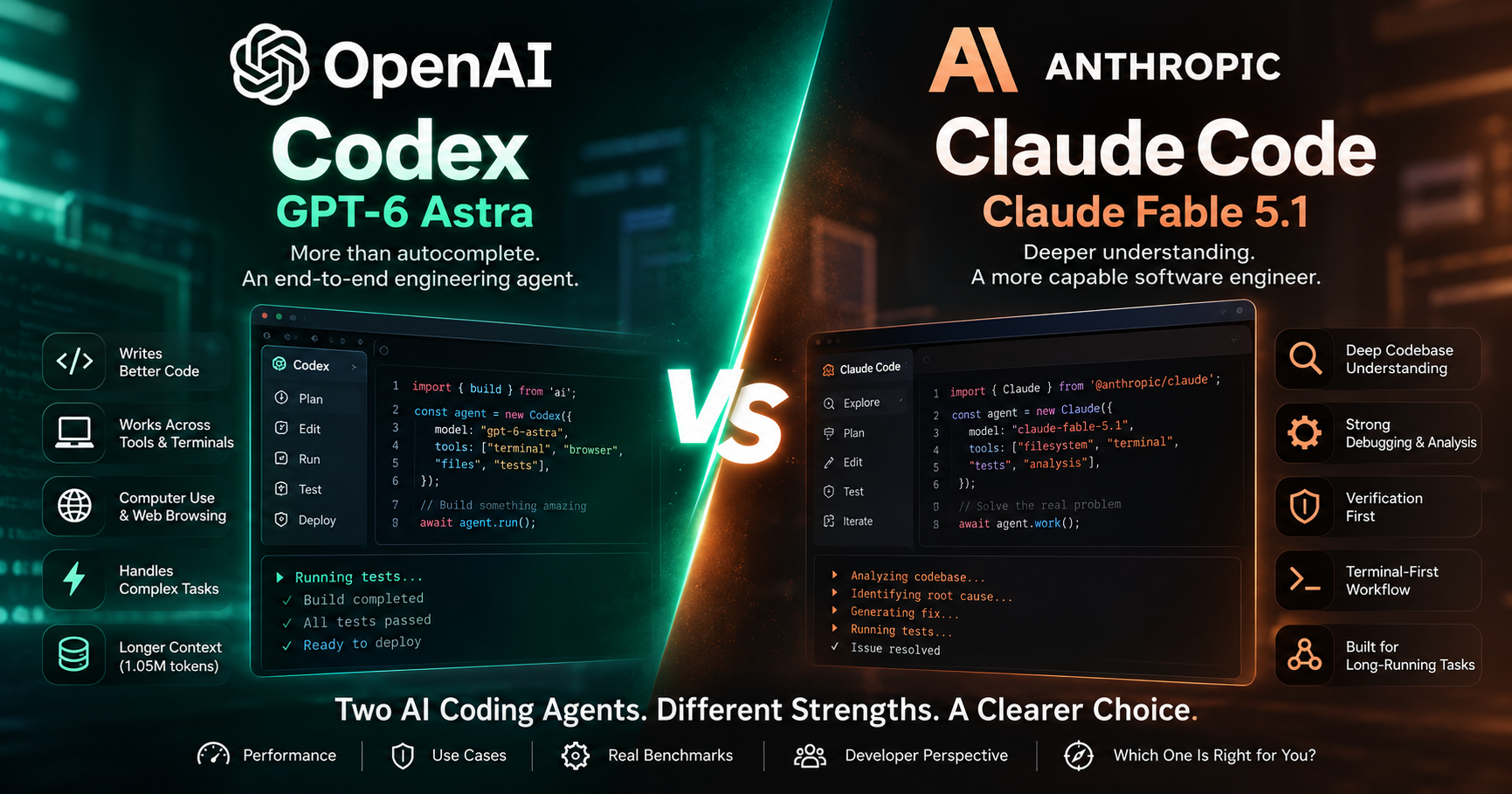
OpenAI gives all three GPT-5.6 variants a 1.05M-token context window, while Gemini 3.8 Flash provides roughly 1.05M tokens of input context and is explicitly optimized for long-horizon software engineering.
Coding Performance
This is where the comparison gets interesting.
Google reports Gemini 3.1 Pro at 80.6% on SWE-Bench Verified and 54.2% on SWE-Bench Pro. It also reports 94.3% GPQA Diamond and 68.5% Terminal-Bench 2.0.
OpenAI's GPT-5.6 Sol reports 64.6% on SWE-Bench Pro, 72.7% on DeepSWE v1.1, and 88.8% on Terminal-Bench 2.1. GPT-6 Astra reaches 74.1% on DeepSWE v1.1.
Gemini 3.8 Flash is the surprise.
Google reports 73.7% on DeepSWE v1.1 and 89.4% on Terminal-Bench 2.1, putting it extremely close to Astra and slightly ahead of Sol on those specific tests.
But this does not make Gemini 3.8 Flash the better coding model overall.
Astra still has the stronger top-end combination of reasoning, coding and computer-use capabilities, while Sol remains a very strong professional model with substantially lower pricing than Astra. OpenAI explicitly recommends Astra for the hardest coding work and Sol for complex professional workloads.
Where OpenAI Is Better?
Deep Engineering
GPT-6 Astra is the strongest option when the task is not merely “write code,” but understand the system, use tools, debug it, verify it and finish the job.
OpenAI says Astra is designed for the hardest end-to-end work and supports web search, file search, computer use and other tools. It also says Astra is generally better than previous models at maintaining coherence during long tasks.
Computer and Agentic Work
This is where OpenAI has a clearer advantage.
Astra is built around computer use and broader professional workflows rather than coding alone. For developers building agents, browser automation and software-operating workflows, Astra is the stronger choice.
Professional Coding at Different Budgets
OpenAI's model family gives developers a useful ladder:
Astra for maximum capability, Sol for serious engineering at lower cost, Terra for balancing cost and intelligence.
That makes the OpenAI lineup easier to deploy across different workloads.
Where Gemini Is Better?
Multimodal Development
Gemini 3.1 Pro's major strength is breadth.
Google positions it as its strongest multimodal model, with text, image, video, audio and PDF understanding, alongside a 1M-token context window.
For developers working with screenshots, documentation, diagrams, videos and large technical inputs, Gemini is extremely capable.
Coding at High Speed and Low Cost
Gemini 3.8 Flash is the most interesting Google model for developers right now.
Google explicitly designed it for long-horizon software engineering, autonomous agents and complex enterprise workflows, while keeping Flash-level pricing.
It can therefore be used as a high-volume coding workhorse where running the absolute flagship model on every task would be wasteful.
Algorithmic and Research-Heavy Work
Gemini 3.1 Pro remains particularly compelling for difficult reasoning and multimodal technical work. Google's published results show very strong performance on GPQA Diamond, ARC-AGI-2 and SWE-Bench Verified.
What Developers Actually Notice
Real developer feedback is much less one-sided than benchmark debates suggest.
Recent discussions around Gemini 3.8 Flash repeatedly describe it as dramatically better than earlier Gemini coding models, with some developers saying it is fast enough to replace their previous coding model. Others still report that Astra handles the hardest architecture and reasoning problems better.
That matches the benchmark pattern.
Gemini has become much better at coding.
But OpenAI still has the stronger ceiling for difficult engineering work.
The difference is especially noticeable when a task requires extensive reasoning, tool orchestration and sustained execution rather than simply generating a good-looking patch.
Which Should Developers Choose?
Choose GPT-6 Astra if you:
Build complex software
Need deep debugging and reasoning
Use autonomous coding agents
Need browser or computer interaction
Want maximum end-to-end capability
Choose GPT-5.6 Sol if you:
Need serious coding without Astra-level cost
Run large numbers of engineering tasks
Want a strong general-purpose professional model
Care about cost/performance balance
Choose GPT-5.6 Terra if you:
Need a cheaper coding workhorse
Run high-volume tasks
Do not need maximum reasoning depth
Choose Gemini 3.1 Pro if you:
Work with multimodal technical material
Handle enormous contexts
Combine coding with research
Need strong reasoning across different input types
Choose Gemini 3.8 Flash if you:
Want very fast coding
Need an inexpensive agentic workhorse
Run large volumes of coding tasks
Want strong long-horizon software engineering without flagship pricing
Reality Check
The biggest mistake is comparing model names instead of workloads.
GPT-6 Astra is the better high-end engineering model.
GPT-5.6 Sol is the better OpenAI workhorse.
Gemini 3.1 Pro is the stronger multimodal specialist.
Gemini 3.8 Flash is Google's most serious challenge to OpenAI's coding workhorses.
And that last point matters.
Gemini 3.8 Flash is not merely “a faster Gemini.” Google specifically built it for long-horizon software engineering, and its published DeepSWE and Terminal-Bench results put it remarkably close to OpenAI's much more expensive models.
But for developers doing the hardest coding, debugging, autonomous execution and computer-based workflows, OpenAI still gets the recommendation.
Use Gemini when speed, multimodality and cost efficiency dominate.
Use OpenAI when correctness, deep reasoning and end-to-end engineering capability matter most.
For serious software development, GPT-6 Astra is the model I would trust first; Gemini 3.8 Flash is the model I would keep beside it.